Sunday, September 17, 2023

In support of a pregnant friend with a struggling man

 I recently received an email from a lover of years past. She is now pregnant and with a man who is very unclear whether he wants to be a father and whom she describes as often angry, distant and reserved. He emphasizes freedom in his spiritual growth and is thus resisting being a father with all the responsibilities that entails. This woman reached out to me asking me for advice. I share my response below:

Good morning [name],

That sounds like a difficult situation to be in. A few things may help -

1. Men's group: He is in a situation which is very difficult to work through without other men, and with time pressure. I strongly encourage he find or start a men's group that meets regularly. It should focus on good men's group things like integrity, facing his fears, taking responsibility for his actions and his life, finding his life purpose and actually walking it, and so on. If this doesn't work out, finding a really good life coach or therapist may help - anyone he can confide in that will both hear him and hold him to a high standard.

2. Choosing from freedom: Freedom for some people can mean, "I have no obligations and nobody expects anything from me". This ultimately is very isolating and not very satisfying, but with this perspective, any obligation/expectation is a burden, a diminishment of freedom. And of course, parenthood with little external support and unsure relationship with baby-mama has a lot of obligations/expectations! Another, deeper sense of freedom is this: "I commit to living the most meaningful life imaginable, to being who I am alive to be. I recognize in my heart I am meant to be a father, and I accept that this pregnancy is a gift in helping me be who I alive to be - a father. This is a challenge to be grateful for." In other words, he must not think of this as a burden or something forced on him, but something that is part of his sacred path, which if you're right that he wants to be a father, it is.

3. Acknowledging fears: If you're right that he really wants to be a father, then the reason he's not excited is because he's scared. The first and hardest step is always to face the fears. Example fears: How will he have to rearrange his life? Will he know how to handle difficult situations with you or the kid? What will he have to give up that might be important to him? What dreams did he have of fatherhood that this doesn't quite match up to? Can he handle a responsibility that lasts the rest of his life, not just a year or two like a job? Will he treat his child the way his parents treated him, or will he do better? Can he afford to take care of the kid and take care of you?

He might not even be able to articulate these fears to himself. The more you can get him to articulate these fears, the better. Once they're out in the open, you can acknowledge your faith in him and simply work through things. Until the fears come out, they remain difficult for you to help with.

4. Bravery and trust: Many men learn not to face their fears, which is exactly what needs to happen in this situation. Again, a good men's group can be extremely helpful. In this situation, it is important for him to find the bravery to face his fears. There are many ways for him to do that. One thing that inspires bravery in men is women's trust. To hear you say "I trust you" or "I have faith in you, I know you can do anything" as you look into his eyes, this is powerful. Of course, you have to find that trustable, brave part of him as you speak so that your words are true. But of course you trust him, or else why would you try to keep him around as the child's father?

A simple mantra which may help him is this: "I can handle anything". Just him saying this over and over may help, and hearing you say it about him may help too, so long as you mean it.

5. You must have faith: This last one is for you. Faith means to trust that the best thing that can happen will happen. If he's meant to be this child's father, he will find it in his heart to show up. if not, he will leave, and that will be the best thing. If you feel afraid and try to pressure and manipulate him, it will do no good, even if he ends up staying a little while before leaving. Build him up, help him be a deeper man, remind him you're in this with him together, and you can do it. If he refuses, keep doing your best - open in spite of his closure, as we used to say together. And ultimately, if he keeps refusing, prepare to take care of yourself and the child without him and be a model of strength and resourcefulness of your child. Find family supporters, find other women friends, do whatever you need to do. I know you can do it, if you need to!

Remember that your choice of father is one of your first gifts to your child. I can tell how much you want this man to be the baby's father. I hope it works out and he finds his true strength. But if not, there are other men, and there are many fathers so bad that it would have been better not to have a father at all. So again, do your best and have faith.

I wish you well! I hope you will let me know how it goes.

Saturday, September 2, 2023

Stigmatizing people with labels of mental health disorders

A number of people have recently become upset with me. I have not heard all the details yet, but it seems related to my recent decision not to work with someone who lied to me and made excuses when I confronted them about it. An informal conversation recently took place between a few dozen people, and I was not there. Some people complained that I am an intense person and sometimes do not notice other peoples' emotions, and a friend diagnosed me with neuro-divergence. She later told me what she said. I wrote the following in response, lightly edited for this blog post. 


I want to respond to your comment about neuro-divergence. We didn’t call it neuro-divergence when you had low self-esteem for much of your life and became very insecure when that social storm happened to you a few years ago, nor when Andrew lied to me then misrepresented my response  to a crowd of other people. We don’t label people with integrity-deficit-disorder or confidence-deficit-disorder.


What behavior people diagnose with a mental health disorder is basically arbitrary. In some cases it may help shed light on some pattern based on chemical toxin exposure, nutrient deficiency, or something else, but mostly it’s a way of stigmatizing certain emotional patterns while tolerating others. Everyone has strengths and weaknesses, and giving people official-sounding medical labels for their weaknesses is unhelpful and dehumanizing. As I like to say - let the person with no emotional issues whatsoever assign the first label.

A major implication of such diagnoses is that the mental/emotional problem is not simply a pattern that can be grown out of, but something inherent and either unhealable or can be healed/covered up only with drugs. For example, when someone gets the label autistic, most people will just lower their expectations for that person rather than help them grow. Once I get labeled neuro-divergent, who would pull me aside to help me see things I don’t? Why help someone if "that’s just how he is"? But I have learned to tune in much better over the years. Why not just say "That's a weakness of Whip's which I've seen him working on"?

Or take the example of depression - I have read repeatedly that one observed pattern is that depressed people are commonly less willing to pretend to believe the lies of the culture around them, and less willing to maintain unfounded optimism than most. No wonder they’re depressed! Better put them on anti-depressants. Many of these people could be great sources of positive change if helped to channel their gifts for the greater good. Instead I believe America drugs its latent spiritual leaders into submission. I believe many heavily diagnosed and drugged Americans simply have gifts that their society does not welcome. Instead of adjusting our unhealthy society, we drug and stigmatize our children into sameness. I don't believe we actually know what a fully emotionally healthy person is even like! Most people have never met one.

So, thanks for telling me what you said. I am still deeply grateful for the stands you took in my defense. And, I do not support that diagnosis and I do not consider it constructive. I ask you to find other ways to help people relate to me and to each other. 

Equity, Integrity, and Solidarity

I work for a nonprofit and recently chose not to work with someone again after he lied to me and refused to commit to being honest in the future. Many people disagree with my stance, and at least some of them do not understand it. I wrote the following to clarify what happened and where I stand.

If someone asked me to summarize all the different equity issues around the world in a single word, I would say ‘solidarity’, with a root word of ‘solid’.

Solidarity - women ask men, “please stand in solidarity with us, recognize our problems are your problems because at root we are one”. Black people ask white people - "Please stand in solidarity with us. Recognize our problems are your problems. If you have privilege, use it in solidarity. Because at root we are one."

It's the same everywhere - rich and poor, adults and children, humans and nonhumans. Solidarity is what’s needed, and what’s missing.

*Solidarity, solidness and integrity* What is needed for solidarity? Every activist ever will tell you solidarity requires solid relationships based on trust; we have to be able to trust each other. And that means we have to tell the truth, we have to keep our promises. Otherwise we will not be solid with each other, and we cannot stand in solidarity, and all our hopes and dreams of being good allies and doing equity work will be for naught.

Since closing circle of Rivercane 2023, I have been involved with staff and leadership in three cases of low integrity. In two cases, a group intended to break a promise or outright state something false when they knew the truth. In the third case, the staff member Andrew did outright knowingly state falsehoods to me.

*Dishonesty poisons relationships* Everybody knows that dishonesty and breaking promises destroys relationships. Your wife, your husband or partner - if they lie, that is hard to come back from. Same with coworkers and friends - if they break promises, it severely limits the relationship. Low integrity is absolutely poisonous to any relationship and any culture. But that doesn’t mean when a person does something wrong I cast them away. Instead I seek to hold others to a high bar, just like I’d want others to hold me to a high bar when I slip. And that’s what I did.

*Holding each other to a high bar* In each case I held the person or group to a high bar and said, to summarize, "we’re better than this. you’re better than this. Let’s find a way to be in integrity, to tell the truth and keep our promises even if people become upset with us because of the stand we’re taking. We can't let fear of others' reactions keep us from doing the right thing."

In the first two low-integrity cases, the group heard me and changed their path. they ended up keeping their promise and telling the truth. It was simple.

With Andrew, I entered a meeting with him and the coordinator Sara with the intention that he would work with us this fall and I would resume trusting him. My first question asked him what exactly he remembered happening last spring between us, and he agreed: at the end of the spring event, he had the correct mileage numbers and knowingly gave me wrong numbers to change the worktraders’ reimbursement amounts.

*I want to trust you and for that I need you to return to integrity* I told him I wanted to trust every word he says, and for that I would need him to ‘return to integrity’, which is a simple process:

  1. Acknowledge what you did and why it wasn’t ok. For example (he didn't say this; it's what I would have wanted to hear): "I deliberately told you wrong information to manipulate reimbursements for worktraders. I see how you wouldn’t trust me after this and I know how important that trust is to you and to me too."

  2. Acknowledge what was going on for you that you chose to lie (show some self-reflection). For example (again, not something he said), "I was afraid you wouldn’t listen and I wanted to give a better rate to the worktraders. I should have trusted you to hear me out, but even if I didn’t trust you or if we disagreed I should have been honest so we can acknowledge any disagreements and always be clear with each other."

  3. Commit to integrity. For example: "I apologize for lying. I commit to always telling the truth and being straight with you. Thank you for hearing me out and recognizing I can come back from my mistake."
The meeting with Andrew could have been 3 minutes long if he had just said this. I spelled out this return-to-integrity procedure very clearly for Andrew repeatedly. What did I hear instead?

Excuses:
  • I was busy
  • Actually Madison told me the idea
  • I was going to tell you the real numbers later
  • I don’t regret what I did.
  • I don’t consider what I did dishonest because I planned to tell you the real numbers later but I never got a chance.
  • I hear how in your experience you might perceive dishonesty, but really that’s just your experience and not my experience because I know I was going to tell the real numbers later.
The nonprofit's head coordinator Sara was there with Andrew and me; she can vouch for all this. After going round in circles for an hour, and hearing the excuses mount, and hearing we have very different understandings of honesty, I drew a line. Andrew would not commit to a path that would let me trust every word he says, and so I would not work with him this fall.

While I acknowledge getting exasperated a few times, I recall remaining very self-controlled, speaking clearly and respectfully the entire time. I practice being direct, clear, and firm on issues like this while also listening carefully and remaining humble and open to feedback. In this case I entered the meeting well prepared with what I wanted to happen to resume trust. Instead of a commitment to integrity I got excuses. Instead of acknowledgement I got shifting definitions of honesty. I would be dishonoring the organization if I handed a budget to someone with a track record of lying to my face and making excuses when confronted with it.

The way I see it, I stood for a culture of integrity, and Andrew voted himself out. It’s not a question of forgiveness. I welcome him back whenever he’s willing to return to integrity.

*We get what we stand for* I believe we get the culture we are willing to stand for. I want to be around people I trust and who trust me. People who hold each other to a high bar so we can do big things in the world together. So long as we tolerate working with people who don’t agree on what ‘honesty’ even means, we will never be solid enough to be in solidarity with others. Without being solid, without integrity, we can spend thousands of hours talking about equity but it will come to nothing and no one will feel better. Thus, I focus on integrity as foundational to equity work. I commit to holding others and myself to a high bar, to being solid, so we can be in solidarity with other people and the earth.

*equity work: I focus on solidarity first, then feelings* Many people seem to approach equity work with the goal of making people feel better. I think this is backwards. Feelings of deep comfort and safety come not from focusing on people's feelings, but by standing in solidarity together, even when we really really don't feel like it. It comes from standing for shared values, shared norms of appropriate behavior. I might have an argument with someone, but I'll feel just fine if I know deep down they'll have my back in any emergency; they'll stand with me if someone behaves disrespectfully towards me.

So long as we focus on making people feel good while tolerating low integrity, I do not believe anyone will ever feel deeply good. The profound shift will come when we agree on shared norms and stand for them no matter what, together. This requires solidarity, which requires solid relationships based on integrity. That's why I'm taking a stand for integrity. 

Tuesday, March 22, 2022

Land Update: February-March 2022

 Here’s a little update on projects I’ve been working on on the Land.


3 Goals

I’ve got 3 overarching goals for the land:

  1. Community: build a space that can house a few families living happily with each other and the earth
  2. Earth: leave the earth here richer and cleaner than I found it
  3. Resilience: Emphasize local resilience: high food production w/relatively low maintenance, a healthy soil that doesn’t need constant amendments, gear and infrastructure that requires minimal electricity and can be maintained with unpowered hand-tools, and so on.

This is a survey of things I’ve done in February and March. Enjoy!


Scavenging for cheap things and old tools

I’ve been scouring Craigslist, flea markets, and other places for old tools and useful things. I’ve found some real gems!

Large glass doors, both straight and curved. Probably for a well-lit bathhouse.

A cast-iron cauldron, estimated 10-12 gallon capacity. Excellent for making broths and dyes and rendering fat. I'm super stoked to have one!

It could use some scrubbing though...

Sawmills make lots of woodchips, shredded mulch, and sawdust they happily give away for free. So many uses!

A local drink-making company very kindly gives away food-grade 55gallon drums. I packed 7 in/on my vehicle, and on this day I felt ok having a small SUV.

The same place that gives away barrels goes through lots of buckets. I snagged a few, and this one has quite a bit of organic ginger juice still in it - super tasty!
 
These are blacksmithing shears. Super useful for cutting thick metal without power. And they're in great shape too!

Sugar maple tree – tapping for sap, making syrup

The rough process here is to put taps into sugar maple trees and catch the sap as it pours out, then boil this down and store the resulting syrup. There are some complexities that make this a fun engineering project! I wish I had pictures of the setup I put on each tree. Sugar maples have the highest sugar-to-sap ratio, but it’s still ~33 gallons of sap to 1 gallon of syrup, so it’s a lot of boiling. For anyone gung-ho to do this, I highly recommend the book “Backyard Sugarin’”.

Definitely NOT an effective way to boil large amounts of sap down. I'm happy to say I did better than this later, but don't have pics of it.

This is it! The most excellent sap-boiling device I can imagine! It's a commercial stainless-steel sink I got at a scrapyard. I'm going to weld that little sheet (see inside the sink) over the drain so it becomes just a big pot, and next winter I'll be boiling huge amounts of sap way more efficiently than this winter.


Outdoor sink

I want to live outdoors as much as I can (he says as he types on his screen indoors), so I’ve made an outdoor compu-, ah, I mean, sink. An outdoor sink! This goes with the outdoor fire-heated shower I made last fall.

This is already super-cool, and I ain't done yet. It's on a gravel-and-rock foundation and anchored in  with locust spikes. It's got a roof with a gutter which I'll use to send rainwater to a rain-barrel so it'll be easy to get water into the shower-barrel for boiling for dishes or showers. And there'll be plumbing and valves allowing the same fire-heated water to be used for showers, sink, or both.


Soon the sink and shower’ll be attached, so a person can heat up water once to do dishes as well as take a nice long shower. The barrel is big enough for water for several people’s showers (3 without rushing in my experience) + dishes, so my intention is to make it easy to start a hot fire and rage it, and then do dishes and shower at the same time. I’ll install some valves so it’s easy to send the water out either for a shower or dishes. Probably not both at the same time… but I’m sure I’ll experiment.

This is made with roofing metal left by the previous residents here and scavenged wood from a local building supply place or construction dumpsters. The sink was also left out in the woods by the previous residents. I paid for the screws, and I dropped ~$50 on plumbing gear to attach the sink to the barrel (not shown, I haven’t installed the plumbing yet).


A path

I’m big on erosion control, so I made a path! Whenever it rained I could be walking along, minding my own business, and then my foot slips and I scrape a 1-foot gash into the grass and leave a muddy mess behind. With this path, I don’t do that!

This is made with locust spikes as black locust is relatively rot resistant, tulip poplar and locust posts since I happened to have them available, and wood chips I got for free from a sawmill nearby.

Side-view of the path.

I bought a small SUV w/all-wheel drive, a rav4. It’s super useful, but I’ve hated on SUVs for so long, I still sometimes feel upset that I have one. To help me feel better, I made a promise: I’ll never travel to town and back and return with an empty vehicle. So, it’s always full of compost, mulch, barrels, soil – you name it! Mulch and compost I can get for free, so it helps me make the most of the trips. When I’m consistently using all that space, I feel better about having this big ol’ metal monstros- I mean, nice little SUV.


 The garden!

This garden…. looks the same as it did before I spent many hours working on it.

Before the previous resident died about 6 years ago, she laid down some plastic sheeting to suppress weeds. Little did she know the sheeting would outlast her! (Or maybe she knew, I don’t know). Anyhoo, an inch of soil had grown over the plastic, and grasses and other plants had put roots through it, and it got brittle. I don’t want toxic plastics in my garden, so I did my level best to pull it all up. I know some is still there, but damned if I didn’t get every little scrap I could find! And the garden is ready for bed-making, not a moment too soon.

Along the same path as the shower and sink, I plan to make one large garden bed, plus plant things in the south-facing stream bank. Since that’s too big a project for me right now, I plan to spread a cover crop where those beds will be to start building the soil now with minimal labor.

Also, I’m happy to announce the first little sproutlings of my first garden on the land! 

These are garlic. I usually plant them in late November, and it was mid-December and I didn’t want to prioritize making beds over a bunch of other projects, so I planted garlic cloves in the pile of soil I made from digging out the shower space, and covered it with leaves. They seem quite happy. They’re also quite in the way, as I’d like to move that pile and put steps where the garlic is. Oh well. The steps will wait!


Fruit tree pruning

I had no idea I love fruit tree pruning so much, but… man I love pruning. And it’s one thing when the tree is properly trained and not too tall – that’s fun. But even more fun is after many years of no-training-at-all, when in order to get to the really gnarly branches I had to climb up high and then walk far out on probably-stout-enough branches to give the tree the needed TLC. Nothing like it! Pruning this way is both thought-provoking and death-defying. An intellectual thriller, if you will.

Apple tree, after pruning. Some areas require more pruning, but even I have my death-defying limits, so it'll have to do!

Some of the trees were so poorly trained I couldn’t even climb them to prune, but this one shown here got a few hours of love. I made it all the way to the top!


Winter firewood

I invented a new unit of measurement – the cubic pallet! Of firewood, in this case. This is a mix of tulip poplar and black locust for next winter. After a couple more of these pallets, I’ll have enough.


Nature observation and trash removal

I love watching the golden ragwort bloom. The flowers start as a cluster of purple buds at the base of the plant…

… then the cluster shoots into the air!

And from here the flower bud cluster bursts apart (no pics yet), and then the golden flowers open up. I bent down to take these pictures, and noticed a bit of trash in the stream. Then another, and another.

Next thing I knew, I had multiple mounds of garbage! The previous residents had done what many sadly do, and used the stream bank as a trash pile. Blows my mind. I’m not always in the mood to pick up trash, but when it’s in the stream I can’t help myself. I meant to take a few quick pictures, and 2-3 hours later on a drizzly day I had done a pretty significant stream cleanup!

Filling my li'l SUV-that-could full of this garbage and relieving the land of it all in one trip feels MOST satisfying.


Biochar burn pile

I’m a big fan of making biochar to build soil. As I cut down small trees or create brush, such as through pruning the apple trees, I haul it here and make piles.


After a special burning process, which perhaps I’ll detail later, I get activated charcoal, great for dealing with food poisoning or water purification. After enriching it somehow (ie adding nutrients, such as soaking it in a bucket of urine or food scraps), it becomes enriched activated charcoal, or biochar, and a great soil amendment. I’d love to have a few biochar burns every year as part of feeding the garden.

Ok, quick biochar-making explanation in case I never get around to giving more detail: get a hot fire going, then pull out coals with a hoe and douse them with water to maximize steam, while maintaining the fire. This takes some fun fire-tending skills. Once the last coals are doused, douse it all real good, always maximizing steam. This steam increases the internal surface area of the charcoal, allowing it to soak up more nutrients.


Keylines

I had a few desires here which all had the same answer: keylines!

My desires:

1) build soil in the forest

2) diversify the forest where it had been clearcut, and then only tulip poplar grew afterwards. This point includes building diversity of trees and wildlife habitat.

3) keep water on the land as long as possible after each rain (this increases stream flow and makes the land more drought-resistant).

Keylines can be super involved with big earth-moving equipment, or super simple like what I did. Basically I went to an area that was super dense with young tulip poplars and cut some and laid the trunks down along the contour, perpendicular to the slope. This makes a speedbump for the water as it rains and falls downhill. This both retains water on the land and helps build the soil.

It also opens up canopy space to allow other trees to grow. Speaking of other trees...


Planting fruit and nut trees

Last fall I bought apple, chestnut, and shagbark hickory trees to plant! Super exciting. I admit to feeling nervous about the world food system as the US-Russia tensions lead to rising food prices. [The author carefully avoids his soapbox regarding the propaganda about those tensions].

Me and a young chestnut. I planted this one on a south facing slope.

Still, I planted most of the trees in a way that, while it’ll take longer to begin fruiting, I hope will allow them to fruit consistently even as the climate changes more and more.

Quick version: flowering trees decide to flower when the ground reaches a certain temperature. Trees on south-facing slopes get more sun, so they flower earlier. A late frost that occurs after they flower could kill all the flowers and prevent any fruit from forming that fall even if the tree is otherwise healthy.

Planting on the north-facing slope (I’ve heard east-facing is also fine) mitigates this risk: the trees flower later in the spring because the soil stays cold longer, reducing the risk of the tree flowers succumbing to a late frost.

The downside is that the trees grow slower since they get less sun, meaning it'll be more years 'til they start bearing fruit. So I’m making a long-term investment in the land here by planting on the north slope. Hopefully it works out! As the climate gets weirder, I expect more and more late frosts, and so this is a major strategy for mitigating that issue.

I'm pointing to a baby shagbark hickory. May this tree tower over 100' tall someday and feed hundreds of animals!

Also, I planted the li’l shagbark hickories on the keylines, which will give them water as the water falls down the hill, stops at the keyline-speedbump, and then gets soaked up by the hickory. One resource said shagbark hickories start bearing a lot of nuts after 50-60 years. A long term investment, indeed. Hopefully people or non-humans enjoy them someday.


The End For Now

Well, that’s what I got to show for the last couple months here. I love this land! I look forward to sharing it with other people as I find friends or make friends who’d like to join me out here.


Saturday, July 10, 2021

Doing My Own Due Diligence

I recently bid on land, and to make the bid competitive, I wanted as few conditions as possible. Normally I would do a perc test and a survey at least, but I wanted to know: could I do enough research on my own to skip these steps and still have confidence I’ll be able to live on the land in a good way (perc test) and that I’m buying what I think I’m buying (survey).

I did this research and felt confident enough to skip both perc test and survey. These are my notes on how I did that and what I discovered.

Perc test

“Perc test” is short for percolation test, and it’s a test to see if the soil percolates. If so, you can put a septic system in to handle a building’s human wastes (poop, etc). If not, no go - and you can’t legally live on the land. Normally they’re $300-400 and take a few weeks to schedule.

DIY Perc Testing

You can look up DIY perc tests online and find videos of people digging holes with shovels, filling the holes with water (sometimes multiple fills) and timing the drain rate. I didn’t do this, though.

With a Little Help From My Friends

I did send out a request to friends, my real estate agent’s contacts, and a community listserv asking for people with experience doing perc tests to give their opinion as to whether I could safely skip the perc test in my case. I gave them all the info I had about the lay of the land, water, geology, and soil (see below about soil). I heard from landowners, people who do perc tests professionally, and people in real estate who deal with perc tests a lot, and all of them said I shouldn’t feel concerned, and the land would perc.

Soil Survey Research

I found a county soil map here. It just shows normal parcel boundaries by default, but to see soil data go to the right column, look under “layers” then “images” and click the checkbox next to Soils. I could see exactly what sorts of soils exist on different parts of the land. Then I looked them up in this free soil survey document here. The soil types on the land where I’d consider building are PuE—Porters-Unaka complex, TwD—Toecane-Tusquitee complex, and TwE—Toecane-Tusquitee complex. Each of these is separately described as “well drained” soil, meaning they should perc and accept a septic system.

Of course someday I’ll need to do a perc test to get a septic permit. Given all this, I feel confident I’ll be able to build as I wish.


Doing My Own Survey 

A survey of this land would have cost $7k-$8k and taken ~3 months according to my agent. A little background about surveys: the county map showing parcel outlines is convenient to use, but the document that has legal weight is the deed description of the boundaries, and if the county map and deed disagree, the deed wins.


A survey is a legal document that may or may not be registered with the county, and the purpose is to legally describe exactly the boundaries of a parcel of land. If registered with the county government, it does have legal weight. This is because a survey is based on boundaries described in the deed(s):
  1. Deed Research: The surveyor studies the deed’s boundary descriptions as well as the boundary descriptions of all neighboring deeds. The surveyor tries to resolve any ambiguities or disagreements and decide exactly where the lines are. 
  2. Walk the Land: This is the surveying work we’re used to seeing, where surveyors walk the boundary and flag each point along the way.
All I wanted to know was, “do the boundaries shown by the map match those in the deed?” I decided to try to answer this myself, and I discovered… the answer is a resounding, “No, they don’t match!”

My deed research

I started by accessing the deed for the parcel I wanted to buy. To access a deed in Yancey County, NC, you go here. Access the parcel you want the deed for by searching by PIN or whatever. Then on the right click ‘Deed Link’ and voila! Here’s the deed for the land I’m buying.

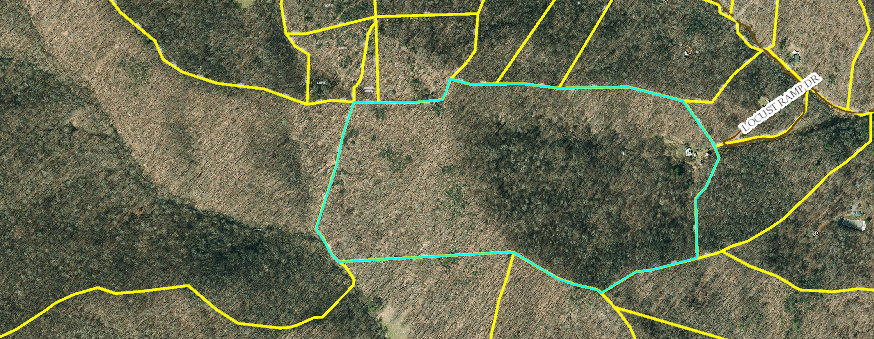
Here’s the boundary the county map shows: 


I went through phrase by phrase in the deed boundary description, and after mapping each phrase to one or more lines, I got this map:

The shaded part is not legally part of the land I wanted to buy! Instead, it belongs to the parcel to the southwest of the land I'm buying.

I was bummed, ‘cause the national forest was supposed to border my land to the west. If my deed didn’t include that western part, which other parcel did? And was I definitely reading my deed boundaries correctly?

Ultimately, I found 3 deeds that confirmed my interpretation as well as a survey for the national forest land to the west. This is the research I presented to the sellers:

The text of three deeds shows that the county gis map for the seller’s parcel (pin 987300506546000) is incorrect and that it does not border the national forest.

From seller’s parcel’s deed:


The deed describes a line going, “Southeast 23 poles to a Chestnut Oak on top of a ridge in W.T. Williams’ line” which describes the boundary to the southeast of the parcel. From there, “thence up said ridge with its main height to the BEGINNING”. The BEGINNING is Bob’s knob, showing the parcel’s true boundaries are the ridge on the south and west, not the forest service line to the west of the ridge.

From parcel with pin 987300417371000, to the northwest of seller’s parcel in the county gis map, with deed here:

“...thence S 3 23 11 W 11.84 feet to an existing iron pin on a ridge, the same being a corner with Baity and in the Northern line of lands of Glenn Wilson described at Deed Book 145, Page 119; then with the northern line of the Wilson property...” The County map shows that this parcel connects with seller’s land, not Glenn Wilson’s. However, the deed references a border with Glenn Wilson’s land.

From Glenn and Phyllis Wilson’s parcel pin 987200388568000, with this deed:

“...thence with Burgess McCurry’s line to the top of Bob’s know...” (probably a misspelling of “Bob’s knob”). This shows Glenn and Phyllis’s land extends to Bob’s Knob. This was confirmed by a call with Glenn Wilson on 6/30/2021.

After sending this research to my real estate agent, she pulled some strings and got a survey to the national forest land to the west and this also confirmed my research.

To Buy or Not To Buy

I felt so sad when I discovered this! I really wanted the land to border the national forest! But I thought about it some more, and I realized a few things…

  • Entrance to the national forest nearby: There’s an entrance to the national forest a mile’s walk/bike/drive down a dead end road.
  • Correct acreage: The county map shows an area of about 54 acres. So the seller’s map is incorrect, but the sellers described the parcel as being 36 acres, and the deed says, “35 acres, more or less”, so the acreage was about as I expected.
  • The boundaries I wanted: I was specifically looking for land where the boundaries are ridges on 3 sides. The deed very clearly says the parcel boundaries are ridges on the north, west, and south.

Given that acreage was as expected, and the most valuable part of the land is indeed described in the deed correctly, I decided to continue with the bid, and we’re now under contract. On my second bid, the seller’s agent told my agent that I came in at the perfect price - the sellers would not have accepted less. And my no-conditions offer was compelling for them, as they received a verbal offer at the same time that would be contingent on a survey - one they knew would yield a nasty surprise for the buyer, as I’d already sent them my deed research! And so the sellers accepted my bid.

I feel 100% confident in my survey/deed research. And I won’t be 100% confident in my perc test research till I get a perc test someday, but for the time being I feel very secure in proceeding with the purchase. It’s been a very long hunt, and I’m very excited to move onto this land!

Tuesday, November 10, 2020

Needles in a Haystack: Finding Gratitude for Trump's Forbidden Truths

I hate being lied to. Trump lied to people a lot, but I tolerated it emotionally way better than during the Obama administration (which I consider equally untrustworthy) because at least now, my friends and family all recognized we couldn't take what the president said at face value. Among my friends we could have clear conversations about Trump.

Instead of having to point out the president's lies, I find myself having to point out the media's lies - lying through over-emphasizing, censoring, slanting; by choosing whom to interview and whom not, by selectively projecting attitudes of disdain or humility as suits their desired narrative, by taking advantage of your predispositions to get you to believe things that seem plausible but are wrong - the media grooms people in a thousand ways. And they're really good at it.

The goal of this essay is to show how the media distorts our understanding, and I'll do that by contradicting one of the dominant media narratives of our time - that Trump never said anything of value, or never told the truth in a substantive way. My goal isn't to support Trump (if it was, I'd have posted this before the election), but rather to show that the media successfully suppressed some valuable points Trump tried to get across. And if we don't want the corporate or oligarch-influenced media to limit our awareness, we need to find alternative ways of seeking the truth.

Before diving in...

* This isn't a pro-Trump essay. I don't support 99% of his actions and words, and like all presidents he caused tremendous suffering and confusion in America and around the world. But the truths I highlight below are still worth recognizing.
* As you read, see if you notice a theme.

So, without further ado, here are some profound truths from Trump which I was grateful to hear.


It was a mistake for Bush to attack Iraq and Bush lied about his real motivation for attacking

As far as I know, Trump is the first big name politician to explicitly acknowledge Bush lied to get America into Iraq (a war Biden strongly supported too) and that America had no business invading that country. And this was spoken by a Republican at a presidential debate no less!


Politicians (and George Bush JR after 9/11 especially) commonly wrap themselves in the flag, pretending people who oppose their policies oppose the soldiers and America. This makes it hard to speak the truth publicly without risking friendships and having your name slandered. Finally a major politician publicly called Bush out on his lies.

Generals often push for war for personal and corporate profit 

I was reminded of the great Smedley Butler (a US Marine General and author of the free book War is a Racket) watching this little clip of Trump speaking. Who thought a president would ever call out military corruption so directly! I'm not sure how to embed the short video, so please just click the link to watch it. Trump speaks in the first 40 seconds, but the whole thing is worth watching.

Smedley Butler's succinct book describes many ways American corporate and political leaders profit from war at public expense. One way is this: Many American generals will speak lofty words of respect and selfless honor even as they retire to go off to work on the boards of directors of large corporations which direct American foreign policy towards more war and more military spending, regardless the long-term benefit to America. It's a form of  honest graft: like dishonest graft it's still self-serving and terrible for America, but since it's not punished by police and everyone does it, people who engage in this behavior can maintain a self-image of being good American public servants. And this is just one easy-to-summarize example of this war-related honest graft. For an excellent but partial list of the American generals and colonels from the Afghan war now working corporate gigs, and what that sort of 'work' looks like, click here. For an insider's perspective written by an officer which explains how the military produces generals like this, click here.

Hearing a president speak to the truth - that many high-ranking people in fancy suits and uniforms who pretend to be patriotic while supporting endless wars are actually full of shit and acting selfishly - this was good to hear.  Obviously the Trump administration still brought much suffering around the world, so it's not like he's any anti-war hero, but I still found it gratifying to hear these words from a politician.

Calling American generals "losers" he "wouldn't go to war with"

When I see military leaders testifying before congress, they engage in so much pomp and circumstance. There's this presumption military leaders are very competent and that they're selfless servants seeking only to keep America safe. They're the 'serious people', the 'adults in the room'.  In the previous section, we saw Trump call out generals for seeking war for profit. In this section, we see Trump calling out generals for being incompetent, obliterating this pretense of military competence in 2017 in a meeting with America's top generals and other top leaders.

Trump reportedly said[3], face-to-face with America's top generals: 

"I want to win. We don’t win any wars anymore," 

and 

"I wouldn’t go to war with you people." 

and 

"You're a bunch of dopes and babies."

Trump punctured this self-image of competence by calling out the consistent poor military performance, and the military leaders felt hurt and disrespected. Good. The first step to fixing anything is to tell the truth others are afraid to acknowledge.

There's so much to love in this article. How about this: 

Trump questioned why the United States couldn’t get some oil as payment for the troops stationed in the Persian Gulf. “We spent $7 trillion; they’re ripping us off,” Trump boomed. “Where is the f---ing oil?” 

Remember the Republicans claiming Iraqi oil would pay for the invasion? Well it didn't! They didn't take this claim seriously, it was just BS to get America into a BS war. I suspect the generals also didn't take this claim seriously either.

Trump doesn't care about the collateral damage (ie all the unnecessary human and non-human suffering); he just wants American imperialism to pay for itself. Even that seems too much to ask. The generals tried to acknowledge non-financial and indirect ways in which war benefits US empire. In narrow ways they may have been correct, but US militarism is obviously not self-sustaining now, or else the empire wouldn't be collapsing as it clearly has over the past 15+ years. My sense is Trump recognizes this at a gut level and wanted to change course.

I'll add the usual caveats:

* Obviously, as this article describes, Trump's own attitude was very selfish, wanting so-called allies to pay for the American troops which America imposes on them and wanting imperial victims like Afghanistan to pay in oil or minerals for being conquered.
* I strongly prefer that the alternative to 'losing wars' is 'only fighting wars in actual self-defense', and Trump didn't mean that. I oppose US imperialism and support a transition away from an industrialized economy that requires foreign wars to maintain the American way of life.
* Little seems to have changed after this incident.
 

Even with these caveats, I'll take a little bullshit-puncturing truth-telling over none at all.

Allegedly calling soldiers 'suckers'

This is the only quote I include in this essay which Trump denies saying. So to be clear: some people claim they heard him say it, but I don't know whether he truly said this or not. It may just be a smear job. But it's still worth sharing as I describe below.

The story: Trump was scheduled in 2018 to take a helicopter to visit a cemetery in France where dead American soldiers are buried. When weather made this impossible, he supposedly discussed options for attending by car, but said he didn't want to go because the people buried there are 'suckers' and 'losers'.

Assuming Trump said this, it isn't 'false' or 'true' so much as an honest expression of his feelings. I include this quote because I suspect Trump believes it whether he said it or not, and more importantly, because I suspect it's actually a common attitude among American political and war-profiteer corporate elites towards soldiers: that they're suckers.

Put yourself in their shoes: Imagine if you were a con-man and all you had to do was keep saying the same sort of lie over and over, and people kept believing you even as they got killed and maimed and traumatized, and you kept getting richer and richer at no personal risk. Sounds like a pretty sweet scam, right? Sure, it causes tremendous suffering and waste and pollution, but the con-men bear no risk and consistently make huge profits - and the con never changes! The same dumb game keeps working over and over. From such a dishonest person's perspective, the people who believe the lies and bear all the personal risk with no prospect of reward might seem like suckers.

One example of this con is the life of Dick Cheney: he worked in the white house and congress for a few decades, then worked as secretary of defense in the early 90s under Bush 1. He left the government and become CEO of a major war contractor, Halliburton, and over 5 years earned $72.5 million dollars. Think about that: he had no experience working in business from the 1970s till leaving government in 1993, then was instantly made the top leader of a large war-profiteer company and made millions of dollars. Then he returned to government as the vice president, ordered or encouraged a bunch more wars with president Bush, and then left office again. He's now estimated to own $100 million dollars. He bore no personal risk and made big bucks while sending others to their death on all manner of false pretenses (see Iraq war for example).

This con,  unfortunately, is not unique to America. It happens the same in every country, and was most succinctly described in an interview with the second-in-command Nazi Hermann Goering in 1946:

[Goering] "Why, of course, the people don't want war," Goering shrugged. "Why would some poor slob on a farm want to risk his life in a war when the best that he can get out of it is to come back to his farm in one piece. Naturally, the common people don't want war; neither in Russia nor in England nor in America, nor for that matter in Germany. That is understood. But, after all, it is the leaders of the country who determine the policy and it is always a simple matter to drag the people along, whether it is a democracy or a fascist dictatorship or a Parliament or a Communist dictatorship."

[interviewer] "There is one difference," I pointed out. "In a democracy the people have some say in the matter through their elected representatives, and in the United States only Congress can declare wars."

[Goering] "Oh, that is all well and good, but, voice or no voice, the people can always be brought to the bidding of the leaders. That is easy. All you have to do is tell them they are being attacked and denounce the pacifists for lack of patriotism and exposing the country to danger. It works the same way in any country."

This con is alive and well in America. Every war is based on lies[1] and makes a few very rich at the expense of many. Trump honestly expressed the callousness many elites feel[2], which was a big no-no. Unlike Trump's remarks about the generals, I didn't feel any gratification hearing this alleged comment of his. I felt sad, knowing how deeply many soldiers care for their country, and how American leadership violates their trust. It's just a reminder of one of the many scams we're all subjected to continuously in this culture.

Summary

At the top of this essay, I asked you to consider to look for a unifying theme.

Here's my answer: 

* Every section involves war, one of the topics about which the media lies most consistently.
* In the first 3 sections, Trump basically points out the Emperor has no clothes. Consider this summary of the above sections:

    1. "A previous president lied about something really important"
    2. "Generals sometimes act selfishly, and not with the country's best interest at heart"
    3. "Many generals are not very competent and lose wars"
    4. "I [Trump] do not respect soldiers"

Items 1-3 are all pointing out major deficiencies in political and military leaders and institutions, and the military is one of the most trusted institutions in this country! These were major 'emperor has no clothes' moments, and so it's no wonder that the media downplayed, distorted, or ignored them.

Here are some key lessons I'm taking away from this:

  • Know my biases: Progressives were already predisposed to dislike and distrust Trump, and so it was easy for the media to convince them he never said or did anything they might approve of. But certainly most progressives would support calling out lies and selfish behavior among politicians and military leadership. I must be aware of my biases so I'm not easily fooled.
  • Avoid good-guy/bad-guy caricatures: No matter what, always see people as people and know them as they are, not as caricatures. There are no heroes and no uniquely bad devils, though I may trust some more than others, and there are some people whose actions I support more often than others'.
  • The media will lie about "emperor has no clothes" moments: The reason everyone pretends the naked emperor has no clothes is because the media and other officials pretend. We must see that the media is already not on the side of bringing us deep awareness, and not let the media blind us to these moments of truth.
Finally, I'll note that many others have written great analyses about media distortions. Aaron Mate's great Russiagate analysis comes to mind. Caitlin Johnstone and Jimmy Dore show how the media fosters fatigue and fear and blames it on Trump. But as far as I know, nobody's discussed media distortions of worthwhile things Trump did say.

Gratitude

I've studied the media and history a lot, but far and away the two most helpful resources were Chomsky and Herman's Manufacturing Consent and the NakedCapitalism blog run by Yves Smith. Many other writings, such as Lies My Teacher Told Me and many works by Native Americans like Ohiyesa/Charles Alexander Eastman's The Soul of the Indian helped open my eyes and my heart to seek deeper truths than I learned growing up. Many thanks to those who helped me on this path. May I pay it forward.

Final words

It doesn't have to be this way. We don't need to keep falling for the same dumb war con (as described by the Nazi Goering) over and over. Native American cultures were healthier and show us a better way. According to his free autobiography, when the Apache Geronimo wanted to gather men to fight in defense of his people and land after Mexicans had attacked his village and killed his family, he visited campfires in village after village to speak and recruit face-to-face. Around these campfires people discussed the true threats to their communities and, as courageous and deeply caring men and women, they personally took responsibility for their collective well-being in making their own informed decision about whether to go to war. There was no con as they discussed war, no grifting. Every country in the world seems to fall for this war con, but indigenous cultures did not. We would be wise to learn from them.

Footnotes
=======
[1] Writing this, I wonder what wars I would have supported. I'd have supported self-defense in the war of 1812. But I can't think of a war of actual self-defense since then. The US goaded Japan to attack the US in 1941 by putting very damaging sanctions on Japan months before the Pearl Harbor attack. The US hid weapons in the passenger ship Lusitania and then pretended Germany attacked a helpless passenger ship as an excuse to enter WWI. The US said it didn't care about Iraq's relationship with Kuwait, tacitly encouraging Saddam Hussein to attack Kuwait in 1990 before using that as an excuse to attack Iraq, etc.  The US constantly lied about indigenous people to justify attacking them for centuries, which continues today. Etc.


[2] I recognize there's more nuance here: you could definitely argue that Trump didn't mean 'suckers' in the way I described. Trump often calls people who die or "don't win" in some way 'losers'. In that sense, merely dying made these dead soldiers 'losers' to Trump. But 'suckers' is different: suckers die for somebody else's benefit while believing something false. While Trump also apparently doesn't believe in altruism at all, I suspect that Trump, ever the con-man, instinctually understands this dynamic I describe. 

[3] Even in articles like this, you can see many subtle ways the author slants readers against Trump. This is easily done, because Trump often was ignorant and foolish. But he also seemed to call out bullshit in ways no others would, including significant parts of American foreign policy. He didn't defend his views with long analysis, but just by pointing out the idiocy he noticed. This brings to mind Nassim Nicholas Taleb's discussion in Antifragile of the difference between the educated and the uneducated: the educated have their intuition snuffed out and learn to believe obvious BS, whereas the uneducated are more likely to notice institutional idiocy. Trump was so full of shit so often, and so unable to articulate his useful insights when he had them, that he wasn't able to change much as president. But noticing that American empire is not paying for itself seems like a reasonable insight to me.

Monday, December 16, 2019

Spiritual Growth after Getting the Tar Beat out of Me


[This story happened to me in March 2019, and I wrote this story then.]

I sometimes struggle feeling like I don't have a purpose or goal, something to work hard at that matters and that pushes me so hard that I fail often even though I give it my best.  There's nothing pushing me that I can push back against, that demands my very best and demands I work through my fears and inhibitions. Without the external pressure, I sometimes find it hard to give things my all.

But not this morning.

This morning, I entered a boxing+kickboxing ring to spar with a much more trained fighter. I expected light sparring, in part because it was just my 3rd or 4th class, but he attacked without letting up. I received continuous hard punches and kicks to my face, head, torso, and legs, front and sides, and the only thing stopping him was my maintaining my composure and blocking, countering, attacking under great duress, which I mostly did pretty poorly. I sensed in intimate detail when I emotionally withdrew, when my posture was poor, when I exposed myself unnecessarily, when I my effort or focus were weak, and so on - 'cause he punched and kicked the shit out of me every time I failed to stay fully present in every way, not just emotionally, but with every part of my body!

I felt my brain rattle in my head several times. I tried to counterattack, but often he simultaneously parried and landed very hard punches and a few kicks to my face in return, discouraging my attacks. He often got past my efforts at defense too, leading me to sense deep down I didn't know how to stop this violence towards me. I could end the fight anytime, and I did briefly pause it twice when I thought I might black out, but I never considered giving up. Without thinking about it, I approached it like a street fight where I couldn't run away. Hence my sense of feeling trapped and unable to stop this onslaught.

That punishment is a kind of feedback I've missed in my life: someone demanding the best of me in each moment and punishing me in a way that absolutely demands presence and engagement when I fail. It sounds like a loving masculine practice, actually - one man demanding the best from another, and making failures blindingly obvious and unacceptable in each moment but without injury or belittlement, and with encouragement afterwards.

The fight made clear my need to cultivate my killer instinct. I refused to lose, but I lacked an aggressive desire to push through the onslaught, instead mostly hanging on and responding feebly the last 1/2 the time in a defensive posture. I've noticed this weak killer instinct in my grappling, though it hasn't shown up as obviously there for some reason - perhaps because I'm more skilled at grappling, and being totally defeated generally doesn't involve any pain, just the threat of pain. In addition, I realized I consistently pulled my punches, deep down not wanting to actually hit my opponent, and in pulling my punches I would bend my wrist and risk hurting myself if I actually did make contact, further inhibiting my punching. This showed again that while I feel comfortable defending myself, I lack the killer instinct to take the fight to the other person - to actually win.

After I left the ring, I shook and cried in the bathroom. I didn't notice much fear at first, but I recognized that I felt some. I felt into the fear, and in a few moments realized I felt consumed with fear - I was scared as shit in that ring and blocked out awareness of it. Now I embraced the fear instead, and practiced channeling it into strength, practiced punching through my fear to the mirror. I used all the techniques I've learned for dealing with fear: I kept belly-breathing deeply, especially through the nose. I kept feeling the fear and shaking or crying, rather than disassociating. Looking at a mirror helped, and made it clear how scared I'd become. I looked like a big little boy, shoulders up and forward, back hunched, looking small, face scrunched in pain and fear, tears coming down.

After a little while, I sought to transform the fear-energy and trembling into strength, not through blocking awareness but by recognizing that I could persevere through fear, and thus transform it into strength. I oscillated between pure-fear and fear-strength for awhile, finally arriving at a strength I hadn't felt in a very long time. This too I saw reflected in the mirror. My face was still scrunched and lines of tears still shown, but I stood tall, shoulders square, head up with an expression of defiance.

I wanted to be able to return to fighting even while feeling fear, and likewise in regular life to not let fear stop me from doing what I need to do. Finally I felt like I'd processed the fear, even though I hadn't used any words or relied on anyone else. I saw the scale in the corner of the bathroom, and as I went to step on it, I felt like a fucking man was standing on that scale finally. Words can't describe how powerful that felt. My shoulders totally relaxed suddenly, and upper back too. The tension mostly returned slowly over the next 2 hours, but the feeling didn't totally go away. I look forward to the next sparring match, and I feel excited to learn the emotional and technical techniques to fight better. These will carry over into the rest of my life in infinite ways.

As I drove away, I sensed that same defensive posture I described above in much of my life right now - little ferocity, but sufficient energy to protect what I have and live comfortably. The fight clearly showed me my attitudes which I carry every day. I want to cultivate my ferocity, that capacity to maintain perfect presence and do what needs doing no matter the fear I feel, embracing any fear rather than shying away. There's much about the world I wish to change for the better, and it's time to stop hiding from the fears that stop me giving my deepest gifts.

Lastly: I feel satisfied with how I processed the fear. In the hours and days since that morning, I haven't felt any residual tension or fear when remembering the fight or its aftermath. I remember feeling fear, but it's not stuck in my body anymore. I learned what I needed to learn from it. I've never been able to consciously feel and transform my energy in this way, and I feel glad I've learned to do so.

Tuesday, June 25, 2019

510 Pullups in a Day

On June 23, 2019, I did 510 pullups between 6:15AM and 6:45PM. I'd like to share some reflections on the experience, including some background, the flow of the day, technical aspects of the training that especially helped, and spiritual patterns I've integrated into my training and their role in the day. I'll finish with final reflections and gratitude to those that helped me get here.

I write a short journal after every training session citing what I liked and what I could improve. This is an extended journal entry for an extended training session.


This is my travel pull-up kit: a small 2x4 carved with notches on the side and bottom to hold a rope firmly. The rope has easily-adjusted bowline loops on both ends to hold the hand-hold and go around a beam. It gives me a lot of flexibility in where I can do pullups, and because the rope rotates as I pull upwards, it reduces strain on my wrists compared with regular pull-up bars. I can do two handed pullups with one hand over the other, or uneven pullups of various kinds. For this challenge, I only did two-handed pullups with one hand cupped over the other.


Background

I couldn't do any pullups at all growing up, not 'til my mid-20s. It wasn't until around the time I turned 30 I could do multiple - I remember feeling so psyched 3 years ago when I got 5 in a row. For years since my late teens I went along without any mentorship in strength training even though I sought it out a few times, learning what I could from various books and people but I never felt like I was growing much. I'm glad that's changed now.

I woke up with a goal of 300 pullups in a day, intending to stay up late or do whatever I needed to get there. My old record was 155, set a month earlier (but I wasn't actually testing my max, I just did a lot of pullups), and before that 100, a record I set in fall 2017.

A month or two ago, I realized I wanted to set ambitious goals for my martial arts and strength trainings to help focus my effort. I only have two friends that especially enjoy pullups, so I asked both separately if they'd like to train up to do 1,000 pullups in a day together, or 500 each by the last day of summer or fall. It seemed outlandishly high, but doable. None of the friends wanted to do it, but I decided to set the goal for myself anyway. I hoped if I could reach 300 in a day yesterday, that would show me how close I was to 500 and what I needed to work on to get there.

I'm visiting my grandmother, and the weather was 100 degrees F hot and dry, so I spent most of the day inside her home resting or outside on the patio doing pullups.

Lastly: In my strength training, I specifically train for for maximum-strength, not strength-endurance, so 500 pullups-in-a-day might at first seem a strange goal. I picked it for a few reasons:
  • Social: I hoped to have an all-day pullup fest with a friend and do 1,000 together, which sounded fun. Sadly it was not to be.
  • Day-long: Normally my training tests/pushes me over seconds or a minute or two at a time. I wanted a day-long challenge for fun and variety.
  • Sounded fun to me: 'nuf said!
Looking back on that list, 'fun' was in all three bullet points. I guess that's the reason for the 500-pullup challenge after all.

Flow of the Day

A key aspect in my training is to never get close to exhaustion. This way the tank always feels full, so to speak, and each set always finishes with me raring to do another one. I'll share more detail below in the 'technical aspects' section, but that desire to avoid exhaustion while maximizing repetitions explains the flow of the day.

I decided to do all pullups in a ladder-pattern, specifically a ladder-5. This means I do 1 pullup then pause, 2 pullups, then pause, then 3, pause, 4, pause, 5, done. For each pause, I walk away from the pullup spot and shake it loose. I call each of these individual sets 'mini-sets'. Each ladder thus yields 15 pullups, 1+2+3+4+5. I'll explain the benefits of this more below in the technical section, but I find this a tremendously helpful training pattern.

I woke up thinking I wasn't feeling up to shooting for 300, and maybe I'd put it off for a couple days. But I often start the day with a ladder-5 of pullups, so I did, and I enjoyed it so I did another. Then it was on!

Between 6:15AM and 8:30, I did 150 pullups, or 10 ladder-5s. At this point, I started thinking seriously about changing my goal to 500.

I connected with my Grandma for a bit, in whose back patio I did almost all the pullups, and then from 9-10AM, I did my daily sit spot, where I go to a particular space nearby and tune in to the life there.

10:00-noon: I did another 150, or 10 ladder-5s. Total by noon: 300.

I started out at 10:00 feeling fresh still, like I'd just done a little warmup. But then I did something a little foolish:

A key practice I cultivate is to always respect the wisdom of the body, and never let the ego-ideals override that. I sensed a desire to get 300 pullups in before noon, and so I rushed my last 3-4 ladders, doing them even when I felt like resting for another minute. If I had needed to do 300 pullups before noon to win a competition, or make money, or ensure I'd reach my 500-goal by bedtime, this'd be just fine. But I did it mostly 'cause I wanted to say I did 300 before noon, and I even knew that was a poor reason, but I went for it anyway. I consider this a minor error. If my goal had been 700, this kind of error where I continue before fully recovering might have meant missing the goal. I never failed to do a pullup, but I struggled on the 15th pullup once or twice in this stretch, and I wondered how well I'd recover during the upcoming break I anticipated after the 300 mark.

12:00-2:30PM: It was a 100oF day in a town appropriately named Bakersfield, California - it baked! So I took off 12:00-2:30 to rest, make a small lunch, and invite my grandmother to tell stories from her childhood. At this point, I decided it was 500 or bust.

2:30-6:45PM: I did the last 210 pullups, or 19 ladder-5s, during this time. My pace slowed a little. I rested more between mini-sets in the ladders, and I rested more between ladders. While resting during the ladder, I'd clean the patio from my seaweed project, or water the plants, or just breathe and tune in to the world around me and my body-feelings. House finches, scrub-jays, and mourning doves sometimes kept me company. Between ladders I'd go inside and talk with my grandmother and reassure her that I wasn't hurt. I'll share more of my in-between-ladders rhythm in the technical section below.

I started feeling a little soreness in my lats around 400, but began doing arm-circles and this mild soreness stopped worsening. A few times in the 300-range I felt soreness in my biceps and shoulders, but I KNEW this meant my form was suffering, so each time I made immediate adjustments and the ache/tiredness went away with the next ladder. I started to feel whole-body-tired in the early 400s, and I knew I could make 500, but it'd take dedication.

I sensed I could get to 600, but it didn't seem worth it. Recovery would take much longer and interfere with other training, and wouldn't demonstrate much more than 500.

My only discomfort came from the rope rubbing against my fingers and causing hot-spots (pre-blisters), as my hand-hold is too narrow.

I finished the last ladder, totaling 510 pullups, knowing I had lots more pullups in me. 600 seemed possible if I just kept on. But I decided to "leave strength in the bank" as Paul Wade of Convict Conditioning put it: unless there's a special need such as a competition, always finish knowing you could do more.

I keep a calendar where I very briefly track the practices I want to do daily or very regularly. Pullups are special: they get a tally mark for every ladder. They normally vary between 50-150 pullups/day when I'm not traveling or resting and then June 23 (bottom left) was different! Adding a tick mark after each ladder was a fun way to celebrate and observe my progress throughout the day.


Technical Aspects of the Training that Helped

Now for some juicy bits. I've focused on learning strength-as-a-skill, and I knew I'd need to push my skills to get to 300-then-500 pullups in a day. Specifically, this demanded:
  • rejuvenating rest: I needed to rest effectively between sets. I had to recover or I'd burn out! I couldn't tolerate any nervous or anxious thinking or urge to continue, or distracted non-rest (like zoning out in front of a TV that would lead to lethargy).
  • body-tension: I practice full-body-tension in my training. Anything less puts substantial strain on the part that's still working (in this case, biceps and shoulders), so I had to be very consistent in my pullups to keep the strain spread out over the whole body rather than concentrated.
  • no exhaustion: If I ever hit exhaustion, my recovery time would spike and I'd probably fail to reach my goal. I had to ensure I never approached exhaustion. 
  • consistency: it's not enough to know good practices, I must do them consistently throughout my training or I'm wasting time and effort. This day-long practice demonstrated my consistency or lack thereof in a way my normal training does not.
Following is list of technical training practices I gave special attention to throughout the day. If I were coaching someone else in this project, I'd include other items for them to consider, so I'll say clearly: this list isn't exhaustive or very detailed. This list is just the set of edges I needed to give special care to; the edges I needed to push to make it to my goal.

Need for relaxation between sets

"Savor the rest" is my motto! Rest isn't 'the time between doing what I want', it's part of the project itself, part of life itself. I practiced enjoying the rest, breathing deeply through the nose, sitting still or moving gently as the desire came to me. Between ladders for the last 150 pullups I did arm circles and jiggled my bicep-muscles to increase blood flow. I practiced feeling everything I could in my body instead of 'powering through' or blotting-out awareness as a way to work through tiredness. Often just putting my attention somewhere - on my back or shoulders or temple - would release tension.

A positive attitude helped. Not an ignore-the-pain kind of fake positivity, but more a relish-the-exhilaration attitude. I could feel my anticipation for the next ladder grow as my muscles and joints recovered each time, moment by moment.

Role of sit-spot / nature connection practices in relaxing

I practiced "owl eyes" and "deer ears" from the Kamana nature connection program. I did most of the pullups in my grandmother's back patio, so there were trees and low plants, birds and insects and a hot sun and dry wind. I practice opening my field of vision as much as possible to sense things in the peripheral area and listening for the quietest sound I can hear. When I notice as much as I can notice this way and really tune in, my facial muscles automatically relax. I did this a few times throughout the day, and going to my sit spot at 9AM and doing this for an hour as I tuned in to the flocks of European starlings, house finches, house sparrows, and robins was wonderfully rejuvenating - I felt fresh as new when I returned even though I'd already done 180 pullups (I snuck in 30 pullups at a playground near my sit spot).

The love I feel for the life all around me when I tune in with these and other Kamana practices really helps me relax in general. More on this in the section on spiritual practices below.

Full-body tension

I often practice the full-body tension immediately before and after the exercise. For pullups, I pull the shoulders down with my armpits (lats), tense the abs/lower back, pinch a coin between my butt cheeks. Those're the basics.

I practice zipping too, which is where you twist each leg into the hip and each arm into its shoulder which helps tremendously: when I do this right while pulling-up, I have the sense that my butt is pushing the rest of me up into the air, rather than being pulled by my arms. It's frickin' awesome!

I commonly practice other max-strength techniques, including special breathing-strength techniques. However, they didn't seem helpful today since I was doing many reps of an easier-to-me exercise rather than a few reps of a difficult exercise, so I didn't practice them.

Now, a cool thing is that after a mini-set or ladder, sometimes I'd feel sore. Often I realized if I just practiced the full-body tension again while standing on the ground, especially pulling the shoulders down hard with my armpits, the soreness would dissipate. And so proper tension was important for both pullups and rest/recovery! How cool is that?


Body awareness

While I'm pulling up, where do I tense and where not? Where do I want to feel tension (butt, abs, back, lats, diaphragm, pelvic floor) and where not (face/head, neck, biceps, etc)? How's my posture? I noticed sometimes I tensed my abs improperly, bending my belly forward rather than keeping it washboard-flat. How does my tension change during the set? I noticed sometimes I'd start properly tensed, and by the end of a 4- or 5- pullup set in a ladder, I'd have lost the butt-tension and only have the abs/back/lats tension left.

My best form would involve full zipping as described above, with the sense that my butt pushes me upwards. So, I asked: is my butt rocketing me up into space? If not, minimally-proper tension without zipping would still be waaaaay better than using shoulder+bicep power alone, a sure prelude to burnout.

Scanning

Scanning is a key body awareness practice I learned from the Tarahumara through the book Born to Run: I scan the body head-to-toe and sense where I feel tension. I did this at two times, immediately after finishing a mini-set inside a ladder and also during the rest periods between ladders, each time with its own intention.

Immediately after finishing a mini-set inside a ladder (say, between the 4-set and 5-set), I sense where I feel tension. If I feel a vague tension throughout my butt/core/lats/shoulders/biceps, I did good! That means the whole body worked together as an integrated being. If I feel extra tension in my biceps and shoulders, that means I didn't have proper full-body tension, and compensated with my arms/shoulders. This way leads to rapid exhaustion/burnout! So I knew immediately I needed to improve my form. This may also indicate is that I didn't properly pull my shoulders down tight with my lats. The proper feeling is that I pull my shoulders down with my armpits. Disconnected shoulders make for wayyyy harder pullups without any compensating benefit. This tuning-in was very helpful in ensuring I consistently had good form throughout the day.

During rest periods, I likewise scanned head-to-toe. What part of me is resting well, and where am I holding tension? Do I feel any anxious-tension anywhere? How is my posture at rest, and how could I improve it to rest better?

No exhaustion

A key to rapid strength training is never ever get close to exhaustion unless you're doing a test or have some clear need. In normal training, don't do it!

I integrated this pattern in two ways: by spreading my pullups out throughout the day, and by using ladders. As I said above, I decided to do all pullups in a ladder-pattern, specifically a ladder-5. This means I do 1 pullup then pause, then 2 pullups, then pause, then 3, pause, 4, pause, 5, done. Each ladder thus yields 15 pullups, 1+2+3+4+5. This way, I could do 15 pullups quickly without ever getting close to tired. I could easily increase rest-time inside the ladder. I only struggled a few times on the 15th pullup (the last pullup of the fifth set), and I never failed.

Likewise, I spaced out my ladders for maximum recovery. I didn't plan my day in advance (see body-based vs time-based rhythm below). Instead, I sensed when I was ready for another ladder, and didn't start sooner nor delay. Often I felt a giddy excitement for another round, and it was time!

Body-based rhythm, not time-based

I kept an eye on a clock to gauge my progress, but I never went outside "because it's time" (except I kinda rushed to get to 300 before noon, but I consider that poor form!) Instead I sensed my readiness and desire, and proceeded to pull-up only when ready. Sometimes this break was short, as when I did 150 pullups in 1.5-2 hours twice. Later in the day the rest was longer, and I took care not to let ego interfere with the rest I needed. But mostly I enjoyed the rest so much - cleaning, talking with my grandmother, observing the plants and birds, feeling how I felt - that I didn't feel much anxious urge to continue anyway.

I've noticed something amazing: I often feel high when I exercise intensively, a natural high, but I'm too mentally-tensed and focused on the task to notice. When I relax into total body awareness and sensory awareness and savor the feeling of what I'm doing, I often notice I'm actually feeling high and didn't even know it. I definitely notice this pattern with my strength training. I noticed it also doing hill sprints this past winter and spring: I'd get to the top of the hill after a long sprint, turn and start walking downhill, and notice I felt very tense. I started to relax, and then felt really high and blissed out. And I realized this high was there all along, if only I had noticed and opened to it. Likewise, many times I felt a similar bliss related to the pullups yesterday.

Summary

Doing so many pullups in a day confirms that I'm not just getting stronger, but I'm learning the physical, emotional, and spiritual skills of moving with strength, and self-training well. I feel very confident that I could train others who want to grow in this way as well. I like that.


Spiritual Patterns

I'll keep this section short, since I still struggle to put into words many of the spiritual practices and patterns I cultivate in my life. But I'll mention a few things:

Eating

I have many unhealthy relationships with food, including anxious eating and overeating in various forms. I'm learning to recognize and change these patterns, but sometimes it seems a slow process of change indeed!

But not yesterday - yesterday it felt easy to eat exactly as I needed to.

I made a way bigger lunch than I meant to, after just hydrating and not eating all morning. And yet, with all the pullups and the body-awareness practice that required, I felt super connected with my gut (or, my ego-self was well integrated with the whole body), and from the large pot I made a small bowl of food, and ate it, and didn't have a single bite more than I needed to feel simply nourished. Often I eat at least a few bites more than I need, leading to a heaviness or lethargy or bloatedness, but I not only didn't do that today, I didn't even feel tempted. This project pushed me to my physical limits, and it was fully my choice, with no sense of external obligation, so I was fully engaged in a way I'm sometimes not. This combination helped me feel more deeply connected with myself, and made it easier to act from my core.

Opening through closure

I practice something I learned from David Deida: Open through the closure! I have chronic tension in my eyes and ears, my jaw, my heart and diaphragm, my shoulders and neck, and so on.  In addition to focusing on one muscle or limb and trying to relax it, I practice feeling as one body that's emotionally-and-physically closed. I feel the physical closure, all the particular muscles that feel tense, and sometimes I even feel them heat up with the attention. Then I open through the closure. The emotional/spiritual opening then happens simultaneously with the physical relaxing.

I struggle to explain this practice clearly in text form. But here're the changes I experience with it:
  • Emotional changes: a greater comfort in my body, more open-mindedness, a sense of bliss or a high, a greater sense of connection with the life and world around me, and an openness to people and the world as they are. I also feel more confident in myself and more grounded.
  • Physical changes: everything relaxes! Sometimes it takes a bit of time and effort, and I've never reached total relaxation yet, but many parts of me relax substantially. Other muscles partially relax and I can feel the residual tension more clearly as tension and often heat. Some muscles tense more, since my posture always spontaneously (unintentionally) improves, but any new muscle tension always seems healthy with this practice, not the result of unaware anxious patterns.
  • Sensory changes: The world becomes more vivid visually; brighter colors, sharper lines. My vision becomes more clear. Hearing likewise improves, and I begin to notice subtle sounds I hadn't noticed a moment before - a motor humming quietly, birds singing in the far distance. I feel the breeze I'd unconsciously ignored a moment before, or other body-sensations or smells I'd not noticed. Often I feel a glow in my heart.
As you can imagine, this practice helped me relax and recover quickly between sets, and also helped me enjoy the rest instead of just waiting for the next set.

Offering my deepest gifts

I began a new practice recently, of offering my pullups and other training as a gift to the world. This combines attitudes I learned from David Deida's teachings with those of natives of the southwest as relayed in Martin Prechtel's books (it's been a long time, and I can't remember their nation's name). But the native people Martin described would run and run and run, and offered their running as a gift to the world; they recognized that their running even helped power the earth and sun. I'm recognizing that just as the birds feeding on the fence or the trees swaying in the breeze are a gift to the universe, so is the prayer of gratitude I offer at my sit spot each day, and so are my pullups. When I offer my pullups as a gift to the universe, I sense my heart open, my eyes and ears relax and take in the world, and my body-awareness increases even more. Everything becomes more vivid, and my focus increases. I disturb the finches and doves and jays less that eat on my grandmother's patio too: I feel more tuned into them and their needs, and they seem to fly away less often or less quickly. And so I love the world more and more with each pullup.

I'm tearing up as I write, even though I'm writing this story for the 3rd time. What a beautiful world this is.

Final Reflections

In my training journals, I always like to summarize clearly what I did well and what I could improve.

Things to improve:
  • goal setting: I set a poor goal in a few ways. 
    • 300 wasn't enough: Superficially, obviously 300 was a poor goal because I reached 500 with energy to spare, so I didn't know ahead of time what would really push my limits. This means I'm not measuring my progress very often. I don't actually mind this much, since my progress still seems real and rapid, and testing often slows progress for a few days (recovery time from exhaustion during a test makes training difficult). But if I'm going to bother setting targets, I want them to push me. I clearly didn't need to train much to reach this goal after first imagining it in May a month ago, so it didn't serve me that much.
    • the exercise must test me: Often, I got through a ladder with subprime posture: merely full body tension, no zipping needed, or worse, just tension in the abs/back/ampits and not the glutes. I didn't need full tension, I didn't need zipping, I didn't need breathing-tension or other max-strength techniques because regular pushups in the 1-5 reps range are too easy for me to need those techniques.  I want the test to demand my best, or even better than my best, so there's a real risk of failing to reach the goal if I don't integrate every practice I've cultivated into the performance. I felt surprised at how sub-par I could occasionally do pullups and still recover for another ladder within a few minutes throughout the day. This speaks well to my strength and endurance, but poorly to my goal-setting.
    • the goal should match the training: I'm doing max-strength training, not strength-endurance training. This challenge was fun, and I'd definitely do it again for fun, but if my intention is to set a goal to motivate my training, I need the goal to be more closely aligned with the training. 5 1-arm pullups by December 31, 2019 would be a better goal than 500 regular pullups. Hmm......
  • notice the closing: throughout the day I kept opening in love and awareness and then unconsciously relaxing back into old patterns of emotional dullness, only to finally notice this and open again. While open I felt fully engaged and vibrant and full of energy, even when tired and sore. While closed, I still felt pretty energetic and amped up, but less aware of my self and surroundings and with more mental tension. Rest time was less restful in this way. The constant physical challenge helped me recognize this. I want to notice the moment of closing and open through that, so that I live open continuously.
  • don't tolerate partial form: Throughout the day, I often tolerated glutes-abs-back-armpits tension without zipping. If I'd zipped properly the whole time, I'd have felt far more energy and less soreness by the end of the day. I want to only practice excellent technique, not partial technique. Otherwise I'll only achieve partial strength and emotional dullness, and who wants that?!
Things I liked:
  • lived the day in prayer: this is the closest I've ever come to living an entire day as a prayer, fully aware and open in love and engaged to give my deepest gifts. I sense I needed the challenge to draw this out of me. I want to live this way always. I suspect I'll be drawing lessons from this for a long time. 
  • rested well: I rested and recovered well and consistently.
  • I did 500 pullups in a day: fuck yeah!


Gratitude

Strength training: Paul Wade, author of Convict Conditioning and Pavel Tsatsouline, author of Naked Warrior. Both offered concrete practices that helped me train far more effectively, safely, and cheaply than I ever had before finding their books. Thanks to them.

Body awareness: Body-based psychotherapists in the Reich/Lowen tradition, including the Gestalt school of body-based psychotherapy have had a big impact on me. Thanks to Wilhelm Reich and Alexander Lowen, as well as the Gestalt contributors (particularly the authors of Gestalt: Excitement and Growth in the Human Personality). Michael Samsel of reichandlowentherapy.org and http://www.michaelsamsel.com/, as well as Jack Willis who wrote "Reichian Therapy, The Techniques for Home Use" (free download here). Many thanks.

Spiritual practices separate from nature connection: David Deida through books and recordings of seminars. Thank you.

Spiritual practices through nature connection: Jon Young through his Kamana program and various recordings. Thank you very much.

These are just the people who've influenced my strength training practices, not a complete list of influential people in my life. Many thanks to all these people and those who taught them. I'm integrating their teachings into my strength training and other aspects of my life in ways deeply satisfying and enlivening. Anyone who would like to learn more about these people or their writings or check out their books, just get in touch.